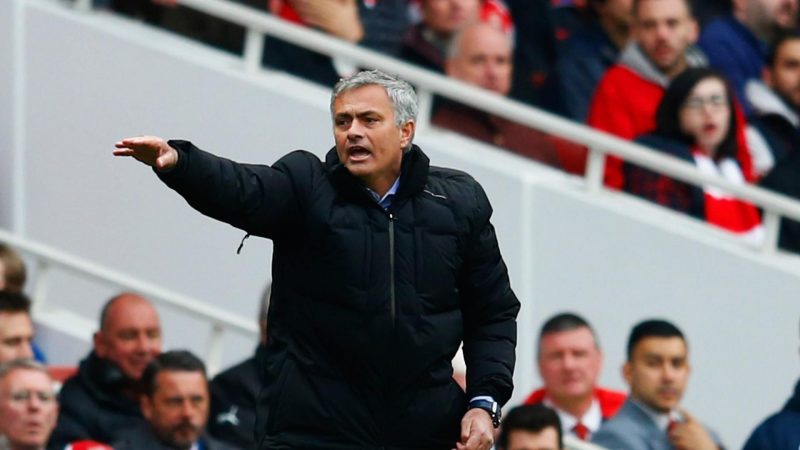
It seems every day in the last month or so has been plagued by the name ‘Mourinho’. Pictures, quotes, comments and statistics contribute to a complete media obsession with the man who has eight League titles, two Champions Leagues trophies and a host of domestic cups to his name. Now, admittedly, if I wasn’t a Chelsea fan then perhaps I wouldn’t be so vulnerable to the name of one of football’s greatest ever managers, and perhaps I wouldn’t even bother writing this article, but I read a piece by Michael Walker in the Daily Mail recently following an interview with Mourinho that opened my eyes to the world of management – not in the tactical or coaching sense, but in the publicity and the struggles of ‘keeping the dressing room’.
In the interview, Mourinho discusses the stability of his position at Chelsea now compared to the stability of his position when he began his managerial career at Benfica in 2000, with the Portuguese side looking far from convincing under Jose’s reigns. I picked out one line that I read back a few times to consider its significance: ‘the negative moment sells’. The more I thought about it, the more I realised that, fundamentally, he is completely right – the negative moment does sell, and that’s not just in football, or in fact just Sport in general!
What Mourinho is currently experiencing is what every non-Mourinho-loving football fan would want – a dark and demoralising spell which diminishes his previous accolades for this moment in time. While Jose’s outburst after a 3-1 home defeat to Southampton emphasised the impact of media pressure on a man in a difficult situation, it also reminded everyone of the fact that he is – unquestionably – the greatest manager in Chelsea’s 110 year history.
‘In this moment, the pressure that I feel is the pressure I put upon myself. I know the world and I know the world of football, people are waiting for the negative moments. The negative moment sells.
‘But really, I don’t feel the kind of pressure of before. Because now I have a history, a big history. I really don’t accept that people can doubt my ability just because I am having some bad results.’
Jose Mourinho, Source: Daily Mail
He’s right. It’s absolutely crazy that the number and the magnitude of the honours Mourinho has won can be called into question after a few lousy performances. Of course every manager should be partially accredited for the performance of a team, but in no way should the integrity of a manager’s ability be called into question after a couple of difficult months; it was only five months ago that Chelsea were crowned Champions of England.
So what is it about the media that makes the life of a manager so difficult? Because it certainly is not just the performances of the Chelsea team that seem to have tainted Mourinho’s affection with football in recent weeks.
Questioned on the introduction of Jurgen Klopp to the Premier League, Mourinho opened another interesting debate on how players should – but perhaps don’t – behave when a new manager is brought into a club.
‘I’m not speaking about Jurgen. I’ve got a good relationship with him and nothing will change that. I’m speaking about the circumstances that made Brendan Rodgers lose his job. I don’t like people being excited that a new manager is coming. I don’t like a player to say, “Now we are going to give extra to prove the new manager”. Give to Brendan! Not to the new manager.”
Arguably the fate of a manager does lie in the players’ hands; if they don’t like their new boss and they choose to be unprofessional about it, it could only be a couple of months before the next guy is brought in. It happened with Andre Villas-Boas at Chelsea and it happens a lot.
That, accompanied by tabloids claiming ‘sources’ have heard of a fall out in the club dressing room, can send a manager insane. But what is Journalism without a story to tell?
‘I don’t like this at all. It’s part of my world I don’t like. My world is changing so much. It’s getting worse.’
In light of manager’s resigning after a tough spell, Mourinho said:
‘You have to be strong enough, brave enough to believe in yourself and go until the moment somebody stops you. That’s what I said.’
It seems the world is waiting for Mourinho to fall, and don’t get me wrong, they have been for a long time. Jose claims that it’s envy which leads to happiness of others in Chelsea’s struggling start to the season – which, as anyone could figure out, is true. It’s no different to the media onslaught that David Moyes faced at Manchester United. Football fans were silent for years in the successful reign of Ferguson at Old Trafford, so as soon as he left and the cracks appeared, it was a big moment for football fans to jump on the sacking bandwagon.
It’s no secret that Mourinho’s ego has upset many, but is it wrong of someone with such a prestigious trophy cabinet to celebrate success? In my eyes success is something that doesn’t last long in the modern world of football. Champions are forgotten about in months, results are forgotten about in weeks and a successful individual performance can be forgotten about in days, providing the player fails to impress next Saturday.
In the case of Mourinho perhaps the story is a little different. Years of victories and a previous history at Chelsea means the club would – if at all – be reluctant to let him go, but for managers elsewhere the roundabout keeps spinning; as we saw in the case of Brendan Rodgers, great moments are easily forgotten in football and particularly in the media.